The Ephraim Schooley House at 15547 Second Street: A Federal-period landmark on nearly four acres in the Village of Waterford

Updated: May 26
Circa 1820 and 1851 | Listed by Christy Hertel and Janeen Marconi of Hunt Country Sotheby's International Realty | Offered at $1,675,000
Among the roughly ninety dwellings that make up the historic core of the Village of Waterford, only a handful sit on parcels large enough to feel, from the back garden, like country properties rather than village ones. Of those, fewer still carry the kind of documented two-hundred-year provenance that historians and preservation societies regard as foundational to Waterford's National Historic Landmark status. The Ephraim Schooley House, at 15547 Second Street, is one of those properties — and it has now been brought to market for the first time in nearly six years.
The home is offered at $1,675,000 by Christy Hertel and Janeen Marconi of Hunt Country Sotheby's International Realty.
A house built in two centuries, in two languages of brick
The story of the home begins in 1820, when John Morrow, a weaver, acquired the land on Second Street and began construction of what is today the shorter, left-hand section of the structure. Morrow's portion was laid in Flemish bond — the more refined and labor-intensive brick pattern of the Federal period, in which headers and stretchers alternate in each course to produce a regular, almost decorative rhythm across the façade. The center window on the left elevation, immediately recognizable to anyone familiar with early Loudoun brickwork, marks the original location of the front door. Morrow operated a weaving establishment from the premises, as did the subsequent occupant, Thomas Donaldson, who wove and dyed both carpet and cloth on site.

The economic depression that followed the Panic of 1819 cost Morrow the property. It was bought at auction in 1824 by Richard Henderson, conveyed in 1830 to the Quaker merchant Jesse Gover, and then in 1834 acquired by Ephraim Schooley, the Quaker for whom the home is named today. Schooley appears in the records of nineteenth-century Waterford town government — among other entries, he was paid 62 cents on April 15, 1837 for the candles that lit the meetings of the town council, which then convened in a rented room belonging to a Mr. Janney. The note survives in the council minutes of that era.
The taller, right-hand section of the home — the portion that today reads as the main mass of the house, with the bay window visible from Second Street — was constructed around 1851 in Common bond brick, a slightly less elaborate pattern in which a single course of headers appears every fifth or sixth course of stretchers. Crucially, both portions of the home were built using "Waterford bricks," fired on the property itself from the local Loudoun clay. For most of the nineteenth century, the two sections functioned as separate dwellings.
The seam where the 1820 Flemish-bond portion meets the 1851 Common-bond addition is one of the quiet architectural pleasures of the home — visible from the street, instructive on the ground, and a reminder that what reads today as a single elegant Federal residence is in fact the layered work of three decades of nineteenth-century builders.
The saddler's Civil War
Saddler Asa Brown occupied the home through the 1850s and 1860s. Brown, a veteran of the War of 1812, was a loyal Unionist — as were his eldest son and two of his daughters — and his household became one of the many in Waterford in which the Civil War was, quite literally, a domestic conflict. His sons Charlie and "Ab" sided with the Confederacy, as did his wife Aurena and a third daughter. The family survived the war, though Charlie was wounded by a Yankee bullet at the First Battle of Bull Run.

The Brown family's experience was, in many ways, the village's experience. Waterford was a Quaker town — pacifist, abolitionist, and overwhelmingly loyal to the Union despite its location in secessionist Virginia. The fight that took place in the village in August 1862, between the Union Loudoun Rangers and the Confederate cavalry of Elijah White, left at least one young Quaker soldier dead inside the Baptist church on Main Street. The village suffered economically and psychologically for decades afterward. The fact that homes like 15547 Second Street survived the period intact, with their original brick, millwork, floors, and fenestration largely undisturbed, is itself a function of the demographic and economic conditions that left Waterford too poor for several generations to alter what its earliest builders had made.
A century of stewardship
Following Brown, the home was sold in 1876 to H. C. Bennett, who reunited the two sections under a single owner. From 1919 to 1959, the property belonged to the H. B. Parker family. Harvey Parker, the elder son, was a blacksmith who returned from the First World War to discover that his brother Fred had taken over his smithy in his absence. The two brothers, according to family accounts preserved in Waterford oral history, never spoke again.
In 1959, Mr. and Mrs. John Lewis purchased the property and undertook its first major restoration. They named it the Parker-Bennett House, in recognition of the two families that had together held it for more than eighty years, and that name appears in many older Waterford references and on the Waterford Foundation's Historic Homes Tour materials. In the 1970s, the Lewises added the two-level rear addition and granted a preservation easement to the Virginia Historic Landmarks Commission, the predecessor of today's Virginia Department of Historic Resources. A further sympathetic addition followed in the 1980s. The easement ensures that the exterior character of the home, the historic fabric, and the open space on the property are protected in perpetuity — a protection that runs with the land and is binding on all future owners.
The current owners, the Manch family, are among the most engaged stewards the home has ever known. The home has been opened to the public on multiple occasions as part of the annual Waterford Fair Historic Homes Tour, most recently in 2025, and a member of the household serves on the board of the Waterford Foundation itself.
The land: nearly four acres backing the Phillips Farm
From Second Street, the house presents as a five-bay Federal residence on a generously sized village lot. What is not visible from the street — and what very few visitors have ever seen — is that the parcel extends back nearly four acres, all the way to the boundary of the permanently protected Phillips Farm.

The Phillips Farm is the 144-acre conservation property owned by the Waterford Foundation and protected in perpetuity from any development. It is the reason that, when standing in the back garden of 15547 Second Street, the view is not the back of another village house but rolling pasture, mature hardwoods, and the gentle slope of the land down toward the Catoctin Creek watershed. It is the same view that Asa Brown's family would have known. It is the same view, in its essentials, that the weaver John Morrow would have seen when he chose the lot in 1820.
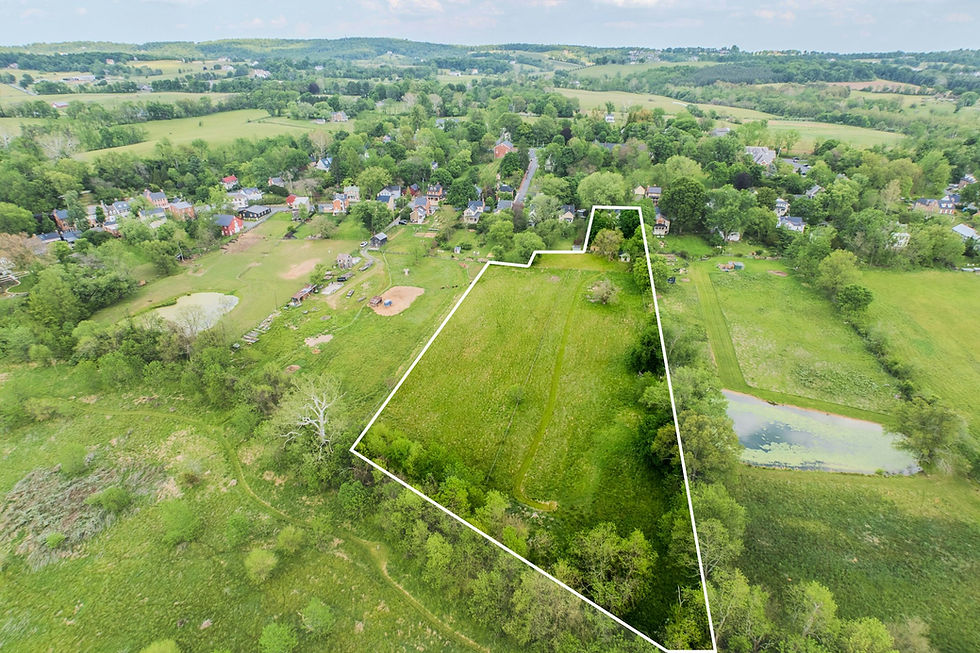
The implications of the Phillips Farm boundary are considerable. There are only a handful of homes inside the historic village whose lots extend to its border, and none of those lots are likely to come to market more than once in any given decade. The protections on the Phillips Farm are permanent. The land is finite. And the homes that share this border — including 15547 Second Street — derive a substantial part of their long-term value from the certainty that the view will never change.

The grounds themselves include mature specimen plantings and gardens, fenced pasture areas suitable for livestock, a garden shed, a peaceful water feature with a waterfall, an extensive flagstone patio with stone retaining walls, and a custom heavy-timber post-and-beam pergola that frames an outdoor dining and seating area beneath an open canopy of trees. A brick walkway connects the patio to a secondary terrace farther into the garden. The detached two-car garage and crushed-stone driveway provide extensive off-street parking — a feature uncommon at a Waterford village address and one that materially expands the home's usability.
Inside: approx. 4,398 finished square feet across three levels
The interior of the home reflects more than two centuries of careful evolution. The original 1820 portion and the 1851 addition were sympathetically integrated during the twentieth-century restorations, and the rear additions of the 1970s and 1980s opened the back of the house to the garden in a way that gives the home its current sense of light and flow.
Upper-level floor plan. The primary suite at the top of the frame (approx. 23 by 15) is anchored by Main-level floor plan. The principal entertaining rooms — formal living room (approx. 24 by 21), fam Upper-level floor plan. The primary suite at the top of the frame (approx. 23 by 15) is anchored by
Main level
A center-hall foyer with wide-plank heart pine flooring, a turned-newel staircase, and the home's original chair-rail-and-wainscot millwork in heritage blue-green opens to the principal entertaining rooms.

To the right of the foyer, the formal dining room (approx. 16 by 10) is anchored by a deep teal palette, original wood floors, period millwork including a dentil cornice, and a corner cabinet original to the home. The space accommodates a long Chippendale-style table for eight to ten guests.

To the left of the foyer, the formal living room (approx. 24 by 21) is the home's largest single space. It features a raised-panel fireplace surround flanked by fluted pilasters, built-in bookshelves and cabinetry, exposed beams, oversized windows, and a wet bar. The room opens through French doors to the rear patio and gardens.

Behind the living room, the family room (approx. 24 by 19) is appointed with crown molding, raised-panel wainscot, a second wood-burning fireplace, built-in cabinetry, and direct sightlines to the kitchen and sunroom beyond. This is the room in which the current owners have most clearly demonstrated the home's capacity to live as a comfortable contemporary residence without compromising its historic character.

The sunroom (approx. 25 by 18) is the home's most lyrical room — a glassed-in pavilion with a brick-tiled floor over radiant heated subflooring, ten-foot ceilings, transom-topped windows on three sides, and direct views of the pergola, the perennial gardens, and the pasture beyond. French doors open from the sunroom onto the patio.

The renovated kitchen (approx. 25 by 11) features custom cabinetry, premium appliances, skylights, and a long working counter that runs the length of the room. It is supported by a generously sized butler's pantry (approx. 12 by 9) and a large mudroom (approx. 9 by 17) filled with natural light from windows on two exposures — an everyday luxury in a home of this age.

A main-level office with built-in features, crown molding, and brick-tile flooring, and an additional small room with a fireplace and brick-tile flooring (likely the home's original keeping room or summer kitchen), complete the main level.
Upper level
The upper level is organized around two staircases — a feature of the home's dual-period construction that allows the primary suite to read as private from the rest of the floor.
The primary bedroom (approx. 23 by 15) occupies the rear of the upper level. It is anchored by a wood-burning fireplace, cathedral ceilings, multiple closets, and views of the garden and pasture from windows on three exposures.

The primary bath (approx. 13 by 8) features double vanities, granite counters, a separate tub, and a stall shower. An adjoining walk-in closet and a dedicated dressing room with additional closets complete the suite.

Three additional bedrooms occupy the upper level (approx. 13 by 17, 12 by 10, and 14 by 10), each with hardwood flooring and several with their own walk-in closets. Two full baths and a dedicated laundry closet round out the floor.
Third floor
The third floor provides a finished loft (approx. 18 by 14) with adjoining walk-in closet, plus a generous attic storage space (approx. 24 by 14). The loft has been used by the current owners as a flexible bedroom, studio, and bonus space.
Architecture and millwork: what the photos don't fully convey
For a buyer with an eye for early American architecture, the most striking aspect of the home is not any single room but the consistency and quality of the original interior millwork carried throughout. The raised-panel fireplace surrounds, the fluted pilasters, the dentil cornices, the boxed and turned newel staircases, the chair-rail-and-wainscot detailing in heritage color palettes, the deep window reveals characteristic of brick walls of this period, the original wide-plank heart pine flooring — all of it is present, all of it is intact, and all of it speaks to the quality of work that the Quaker craftsmen of early-nineteenth-century Loudoun were known for.

The exterior is equally instructive. The standing-seam metal roof, now patinated to a deep slate, is appropriate to the period and to the village. The wood shutters, painted in a heritage green-blue, are operable and on functional hardware. The dentil cornice at the eave runs the full length of the front elevation. The painted brick — a finish original to many Waterford homes and historically accurate to the Federal period — protects the soft, locally fired brick beneath and is itself a feature that requires periodic re-application as a matter of stewardship.

The current owners have completed substantial renovations to the kitchen and the systems while preserving every aspect of the home's historic exterior and interior character. Mechanical improvements include a brand-new central air conditioning system, a high-yield well, public sewer connection, water treatment, and a portable generator hookup. Additional ductless mini-split cooling has been added discreetly to selected upper-floor rooms.
Why the village of Waterford
Waterford was founded in 1733 by Amos and Mary Janney, Quakers who had traveled south from Bucks County, Pennsylvania, in search of fertile land and religious freedom. By the 1830s, the village was a flourishing milling community of approximately seventy houses, with a tannery, a chairmaker, a boot manufacturer, and shops and a tavern serving the surrounding agricultural region. In 1970, Waterford and the agricultural land surrounding the village were designated a National Historic Landmark — the highest level of historic recognition possible in the United States, placing Waterford on the same register as Independence Hall, Mount Vernon, and Colonial Williamsburg.

What distinguishes Waterford from other historic villages on the Eastern seaboard is not only the integrity of its eighteenth- and nineteenth-century building stock but the surrounding agricultural landscape that has been preserved with it. The Waterford Foundation, since its formation in the 1940s, has assembled and protected hundreds of acres of open space adjacent to and within the village core. Conservation easements, façade easements, and the Foundation's direct ownership of properties like the Old Mill, the Second Street School, and the Phillips Farm have together ensured that the village still reads as a coherent eighteenth- and nineteenth-century settlement embedded in actual farmland. There are very few places in the United States where this combination of village fabric and surrounding agricultural landscape has been preserved at this level of intactness.

For a property owner, the practical effect is that the value of a home like 15547 Second Street is supported not only by the building itself but by the permanence of the surrounding context. The view will not change. The character of the village will not change. The Phillips Farm at the rear of the property will not be developed.
At a glance
Address: 15547 Second Street, Waterford, Virginia 20197
Offered at: $1,675,000
MLS: VALO2125946
Bedrooms / bathrooms: 4 bd | 3 full ba | 1 half ba (per Bright MLS; floor plans indicate additional loft sleeping space)
Approx. finished square footage: 4,398 across three finished levels
Approx. lot size: 3.95 acres
Year built: circa 1820 (Flemish-bond left section) and circa 1851 (Common-bond right section); united under single ownership in 1876
Architectural style: Federal period, vernacular Loudoun Virginia
Construction: Painted "Waterford brick" fired on site | stone foundation | standing-seam metal roof
Fireplaces: Three wood-burning
Mechanical: New central air | high-yield well | public sewer | water treatment | generator hookup
Outbuildings: Detached two-car garage | garden shed
Preservation easement: Held by the Virginia Department of Historic Resources
Setting: Backs directly to the Phillips Farm, a permanently protected 144-acre Waterford Foundation property
National Historic Landmark District: Yes (the Village of Waterford was designated a National Historic Landmark in 1970)
Schedule a private showing
The Ephraim Schooley House is offered for private showing by appointment. Inquiries are welcome from qualified buyers and from cooperating brokers.

Christy Hertel | Hunt Country Sotheby's International Realty
(703) 624-6283 | christy.hertel@hcsir.com

Janeen Marconi | Hunt Country Sotheby's International Realty
(703) 401-6465 | janeenmarconi.com
Sources: Waterford Foundation Historic Homes Tour materials (2025); Bright MLS Listing VALO2125946; Virginia Department of Historic Resources; National Park Service, Waterford Historic District National Historic Landmark documentation; "Walk With Us… Waterford, Virginia: A National Historic Landmark," Waterford Foundation; Waterford Town Government minutes, 1836-1837. Property dimensions and square footage are approximate and provided by Bright MLS. Buyers should independently verify all material facts including, but not limited to, square footage, lot size, easement terms, and tax assessment.


Comments